THE MISSING LINK Between the Classroom and the Factory Floor
The new Danfoss fellowship program creates direct collaboration between graduate researchers and advanced manufacturing teams
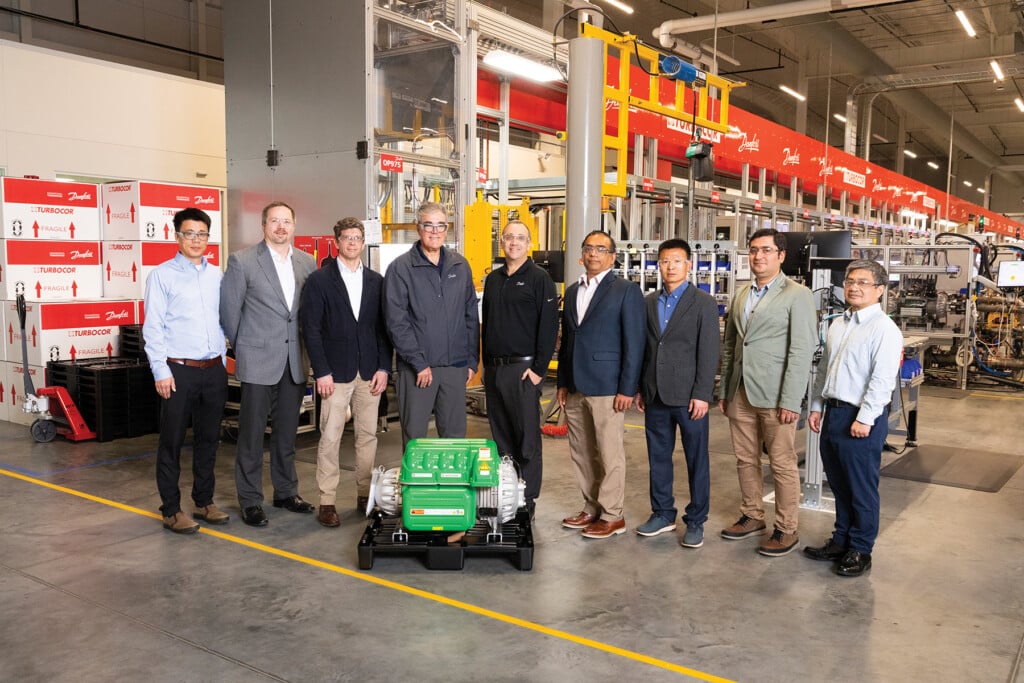
Inside Danfoss Turbocor’s Tallahassee team members from more than 30 countries work on technology aimed at reshaping one of the world’s fastest growing industries: energy-efficient cooling. According to the company, the operation continues to expand as demand grows for advanced cooling systems used in large commercial buildings and hyperscale data centers.
That demand is helping drive a new partnership between FAMU-FSU College of Engineering and Danfoss, which launches the Danfoss Research Fellowship Program to support research in sustainable HVAC systems, energy efficiency, and next-generation cooling technologies.
The fellowship provides up to $25,000 per project to support faculty and graduate students pursuing research connected to real-world engineering challenges.
According to Danfoss and the college, the program pairs academic researchers directly with Danfoss engineers to help accelerate the transition from research to practical application.
For Rogerio Federici, the fellowship represents more than research funding.
“I think the No. 1 benefit that we have is to create this pipeline of talent,” Federici says.
The timing of the partnership aligns with rapid growth in data center infrastructure and the increasing need for efficient cooling systems. Federici says Danfoss’ oil-free magnetic-bearing compressor technology is seeing growing adoption, particularly among hyperscale operators.
“They believe that this is the best fit, not only on efficiency but reliability and total cost of ownership,” he says, adding that major technology companies are increasingly engaging directly with Danfoss in Tallahassee.
That demand is fueling expansion at the local facility. Federici says the company is increasing production, operating around the clock locally for the first time, and preparing to add additional manufacturing capacity in the coming year.
But growth at that scale creates its own pressures.
“It’s not 20% growth. It’s 100% growth,” Federici claims. “And the need that we have for high-level, skilled people is super high.”
The fellowship is designed to help address that need by connecting students and faculty directly with industry problems, whether that involves developing new materials, improving efficiency, or solving manufacturing and supply-chain challenges.
“What we want is to give specific projects to them that they can work together on and bring solutions for us,” Federici says.
Those projects are tied directly to Danfoss’ product development pipeline, giving students exposure to the realities of large-scale engineering and manufacuring environments.
“When I graduated, I thought I learned everything at the university,” Federici says. “Then you start to work, and you say, ‘I don’t know anything.’”
The partnership also strengthens the engineering college’s ability to attract research talent while giving students industry experience before graduation.
“Everybody wins on this,” Federici says.
At the same time, the initiative reflects a broader challenge facing growing companies in smaller markets: attracting and retaining specialized talent.
“It’s difficult to hire in Tallahassee,” Federici says.
The issue extends beyond recruitment. Federici says many interns and graduates come from outside the region, making long-term retention difficult.
“We have 30-plus interns here, and I think we have just one who is actually from Tallahassee,” he says. “The issue for us is always to keep them.”
That reality shapes the company’s long-term strategy. By partnering with local universities and engaging with high schools and technical programs, Danfoss aims to strengthen a local pipeline of engineers and skilled workers.
“If they see this happening in Tallahassee, it can create a different path for them to say, ‘I don’t need to leave,’” Federici says.
Federici describes the fellowship as part of a broader philosophy centered on building relationships between industry, education, and the local community. He points to Danfoss’ Danish headquarters as an example of how long-term collaboration between companies and educational institutions can support regional economic growth over time.
“We understand how important it is to connect with the community and create this kind of ecosystem,” he says.
That approach is beginning to take shape in Tallahassee, where Danfoss says it is working to attract suppliers, support local education initiatives, and expand manufacturing operations in the region.
Even if that growth creates competition for talent in the short term, Federici says the long-term value outweighs the risk.
“We know that this will backfire on us in the first years because we’re going to be fighting for the same resources,” he says. “But we understand that for the long term, this is good for the community, and it will be good for the company.”
The fellowship also carries implications beyond Tallahassee. Federici says customers increasingly evaluate not only technology and production capacity, but also whether companies can sustain innovation through workforce development and long-term investment.
“They want to make sure that we are able to continue innovating and to manufacture,” he says. “And one of the topics they have is exactly the pool of talent.”
He adds that customers also pay increasing attention to how companies engage with local communities and educational institutions.
“When we present what we are doing with local universities, they are super interested,” Federici says.
As Danfoss continues to expand, Federici says the company remains committed to growing its Tallahassee footprint rather than relocating operations elsewhere.
“We prefer the hard way. We want to build this here,” Federici says, adding that their commitment extends beyond manufacturing capacity and business growth.
“We are part of the community already,” Federici explains. “And we want to make sure that the city will thrive.”