Fields of Return
How youth sports investment is creating college pathways in Northwest Florida
Youth sports have become one of Northwest Florida’s quietest economic development engines. Investments in athletic facilities, sports tourism, and community partnerships are generating far more than weekend visitor spending. They are creating pathways to higher education by giving student-athletes greater exposure, stronger competition, and increased access to college scholarships.
From Pensacola to South Walton and Tallahassee, communities are strengthening athletic pipelines in sports that often receive less attention than football and basketball. Baseball, volleyball, track and field, golf, and others benefit from improved facilities, private sponsorships, travel organizations, and regional tournaments that give athletes greater exposure.
The economic impact is easy to measure by hotel rooms at capacity, restaurants filled, and tournament weekends generating revenue. The longer-term return is harder to quantify but often more significant, seen through college commitments, scholarship offers, and families who increasingly see athletics as a pathway to higher education.
South Walton High School offers one example of how quickly investment can reshape expectations. Since opening in 2002, the school has added a $4 million baseball complex in 2021 and an $18 million football and track facility in 2025, with additional projects planned. The investments have expanded hosting opportunities while increasing visibility for student-athletes.

Photos courtesy of South Walton High School Athletics
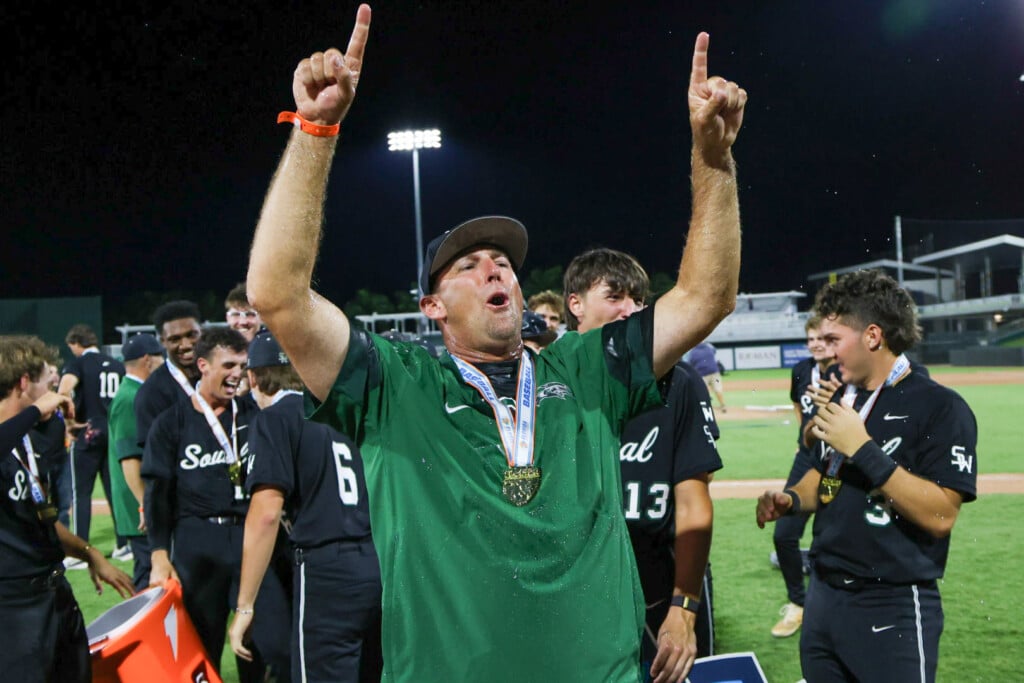
The baseball program became the clearest early return. South Walton finished as the Class 3A state runner-up in 2024 and 2025 before winning the school’s, and Walton County’s, first baseball state championship in 2026 with a 30-4 record. The Hawks travel baseball organization, founded by head coach Nick Borthwick, also became part of the local development pipeline, helping prepare athletes before they reach high school.
The same model is now emerging in track and field.
Track coach Dalton Cooper arrived in South Walton after coaching in Okaloosa County, including powerhouse Niceville High School, where he worked under mentor Todd Brigman.
“I learned that the entire sport could be changed just based on how the coaching staff decides to run their team,” Cooper says.
South Walton’s new eight-lane facility allowed that vision to take shape. With Niceville replacing its track during the 2026 season, South Walton also became an attractive site for regional meets.
“To have that facility and bring teams from as far away as Tallahassee and Jacksonville … that’s absolutely the best thing that we can do,” Cooper says.
The results came quickly. In 2026, South Walton’s boys and girls teams swept district championships for the first time since 2021.
“We absolutely blew it out of the water,” Cooper says. “My staff was able to really put South Walton back on the map.”

Photos courtesy of South Walton High School Athletics
The momentum has translated into college opportunities as well. Pole vaulters Beck and Pierce Williams, brothers who helped give the Seahawks a stronger field-event profile, both signed with the University of South Alabama.
In Pensacola, the connection between athletics and economic development has existed for decades. Pensacola Sports, founded in 1955, is one of the nation’s oldest sports tourism organizations. What began with golf has evolved into a strategy that benefits both the visitor economy and local student-athletes.
President and CEO Ray Palmer points to the organization’s High School All-Star Series, created after Hurricane Ivan disrupted fall sports in 2004. What started as a football game has expanded to eight all-star contests across five sports.
“We make sure that every school has representation,” Palmer says. “You get the small rural high school kids playing against the large schools.”
The same philosophy drives the Senior Scholar Athlete Awards Banquet, which recognizes students for athletics, academics, and community service while connecting many with scholarship opportunities.
“Most of them are golfers, tennis players, volleyball players,” Palmer explains. “It is … possibly the most moving and impressive thing we do.”
Private businesses also play an important role.
Circle K has expanded its partnership with Pensacola Sports, including sponsorship of the Double Bridge Run. Field marketing manager Nick Humphrey says the company values organizations that strengthen local communities, explaining, “We’re very community minded. We really love community partnerships and giving back.” A former Gulf Breeze High School athlete, Humphrey has gained a new appreciation for the network supporting youth athletics. “It’s not just booster clubs,” he explains. “It’s really a lot of people in local businesses that are helping you get to that point.”
For college coaches, stronger local infrastructure creates a stronger recruiting base.
Melissa Wolter, head volleyball coach at the University of West Florida, has built one of Division II’s most successful programs by recruiting heavily throughout the Gulf Coast. She said today’s recruiting depends on competitive club programs, quality tournaments, and repeated exposure against strong opponents.

Photo courtesy of H2 Engineering
“I just think the volleyball in the area is getting better all the time. There’s a real push for growth,” Wolter says. “That makes it easier for us to tap into local talent.”
Hosting tournaments benefits everyone, she adds.
“It brings attention and revenue to the city as well as players to our campus,” Wolter says. “So, it’s a win-win.”
Local partnerships also help talented athletes remain close to home.
“What they do,” Wolter says, “is provide an opportunity to stay local and go to UWF and potentially earn a scholarship.”
For many families, even partial scholarships can make college significantly more affordable. Division II schools often combine athletic awards with academic aid, increasing the total financial package.
“When you offer a student-athlete a scholarship,” Wolter says, “students and parents are overjoyed,” often shedding tears. “Every little bit counts. It’s not the size of the scholarship. It’s the principle of it.”
For families, that can mean less debt and more opportunity. For communities, the cycle continues with improvements. Better facilities attract events, events generate revenue, revenue strengthens programs, and stronger programs create more college opportunities.
For Northwest Florida, the return on investment is no longer theoretical. It is visible in scholarship offers, college commitments, and young athletes discovering that opportunity is not simply found. It is built.
Inside South Walton’s Baseball Pipeline
South Walton baseball’s rise illustrates how modern athletic investment extends beyond wins and losses. Facilities, competitive scheduling, and high-level talent have combined to create a program that consistently attracts college recruiters.
In 2026, Hudson Quinn, now committed to Wallace Community College in Dothan, Alabama, lays down the suicide squeeze bunt that secures the Seahawks’ first state baseball championship. While the play draws national attention, Quinn says it reflects the team’s culture more than any individual moment.
“It was awesome,” Quinn says. “We had a really high standard with all that talent. Everybody was trying to pull their weight equally, and I feel like we all did.”
That talent attracts recruiters. South Walton’s roster features players committed or signed to Auburn, Mississippi State, Virginia, Florida State, Georgia Tech, South Alabama, Georgia Southern, and Troy, creating an environment where scouts regularly evaluate multiple prospects in a single game.
The school’s upgraded baseball complex also makes it possible to launch the South Walton Showdown, an invitation-only tournament featuring championship-caliber programs from Florida, Alabama, Mississippi, Tennessee, and Texas. The event becomes another way the school draws outside teams, college recruiters, and regional attention to Walton County.
“I really didn’t think about the scouts,” Quinn says. “They were going to be there regardless. The whole team was getting scouted by different levels.”
For Quinn, the greatest impact of the investment will be felt by future players.
“Coach being able to work with administration and get the new field helped a lot,” he says. “It brought in so many people. It’s going to create more growth for everyone that comes after us.”