Charged Up
Tallahassee-based start-up, Piersica, has created a buzz in the battery industry
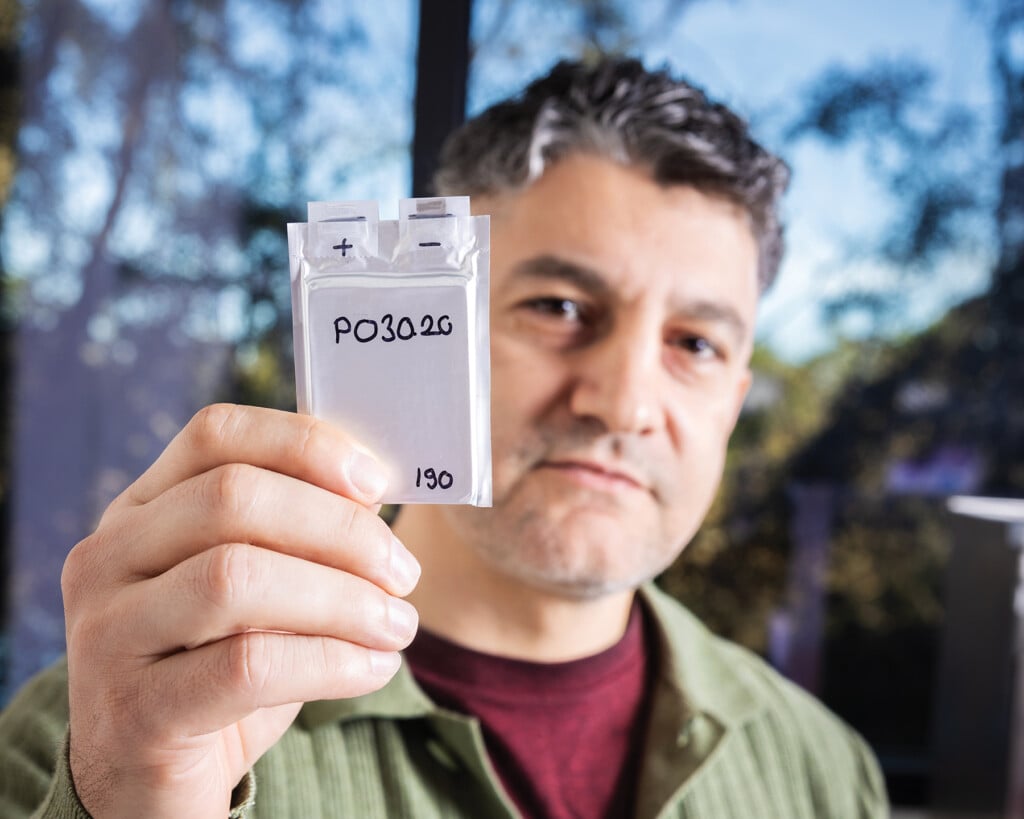
In a not-so-far-off future, commercial flights will possess the ability to operate electrically, and the use of robots will become more commonplace. Piersica, a Tallahassee-based company specializing in high-powered batteries, has developed cutting-edge technology and materials that have the capabilities to revolutionize battery use.
In 2020, after 15 years of working in the battery industry, Dr. Claudiu Bucur, CEO and founder of Piersica, set out on his own to delve into creating a solid-state battery unlike any on the market.
“I want to change the landscape and future of the battery,” Bucur says. “I’ve seen what OEM’s (Original Equipment Manufacturers) are doing, their milestones and roadmaps, and have realized the development pace is often inefficient at large companies. They often rely on start-ups to help provide them the technology.”
Piersica technology enables batteries with an energy density of over 600 watt-hours per kilogram (Wh/kg), which is more than double that of current commercial lithium-ion batteries (around 280 Wh/kg). The result is batteries that charge faster, contain higher voltage, have a lengthened life cycle, improved safety, and competitive pricing.
Bucur patented PIRION™ Polymer Technology, which is the key element that sets their batteries apart.

Photos by Erich Martin
Bucur found that PIRION’s disordered molecular structure enhances lithium salt solubility and ion mobility, creating unmatched conductivity. The polymer’s unique design enables it to be used as a solid polymer electrolyte and an electrode binder.
Alongside superior conductivity, this distinct chemistry produces stable voltage, thermal resilience, and mechanical durability. Currently, lithium-ion batteries are heavy and low-capacity. PIRION™ Polymer Technology enables lightweight, high-capacity solid-state batteries.
“We created a new polymer with very favorable properties that was designed from scratch,” Bucur says. “The existing polymers are not productive in the battery space and are designed for other purposes that aren’t battery specific. Our polymer contains many properties at the same time. It’s like a cross athlete that can run, lift weights, do everything.”
While lithium-ion batteries have existed for over 30 years, commercialized use hasn’t been as successful as it could be because the batteries were extremely heavy. By starting from the materials step rather than engineering, Piersica produced a lightweight, conductive battery that doubles the energy density.
“You don’t want solid-state batteries just because they have the name ‘solid’ in it—you want the performance of a solid-state battery,” Bucur says. “People expect something better than what they have now, and that’s what we can give them.”
In December of 2025, Piersica achieved a major milestone, demonstrating its cell externally to the military with a successful test. This is a positive and promising step in their next direction—manufacturing.

Photos by Erich Martin
Currently, Piersica’s batteries are made by hand. Over the next two years, they will be converting from manual to semi-automation to a fully integrated automated process.
“At the end of the automation process, we will be able to submit industry-standard testing cells to OEM’s to play with them and create their own packs. Once we have a pilot in place, we become contenders for getting customers.”
Bucur notes that this is the stage where most start-ups fail, making its mission all the more critical. Fortunately, they have reached this phase more quickly than their competition and have high hopes for this upcoming phase.
Bucur credits his team, Florida State University’s IGNITE Tallahassee, and grants/funding for Piersica’s success.
Their funding is split between investors and grants from the government and private companies. Notably, they’ve won awards from the U.S. Army, the Shell Game Changer program, and a Phase 2 National Science Foundation (NSF) grant for $1 million.
Piersica is housed inside of IGNITE Tallahassee, a business incubator in Innovation Park, run by Florida State University’s Division of Research. At its start, it occupied one lab; to date, they have five labs.
“Working closely with IGNITE has been instrumental for us,” Bucur says. “We are their first and largest clients here. As soon as they opened, we moved in and have been expanding our footprint ever since.”
David Jacobs, CFO of Piersica adds, “We love being in Florida, especially Tallahassee. The relationship with Florida State University has been particularly great for us because they have an ecosystem built up around companies like us. Additionally, our local vendors and partners have an opportunity to bring significant focus to this industry.”

Photos by Erich Martin
Both note that a start-up like Piersica, in the past, was most likely to exist in the likes of Silicon Valley, but that a lot of cutting-edge companies are seeking the opportunities Florida presents.
The battery market is projected to reach about $300 billion by 2030. Undoubtedly, Piersica, will continue to be a significant contributor to that statistic.
“What we do and the markets we can fulfill are billion- and trillion-dollar markets,” Bucur claims. “It’s very exciting to be a part of and think about.”
Jacobs adds, “We are on the cutting edge, with the ability to successfully enable technology that is not yet available and has the capacity to change lives.” ▪
The Future of Solid-State Batteries and PIRION™
» Electric vehicles
» Electric bikes
» Electric planes
» Consumer electronics
» Power tools
» Robotics
» Consumer electronics
» Medical wearables
» Drones
» Energy storage
» Aerospace and defense