Climate Resiliency in the Bend
Mitigating Risk and Reshaping Our Coast
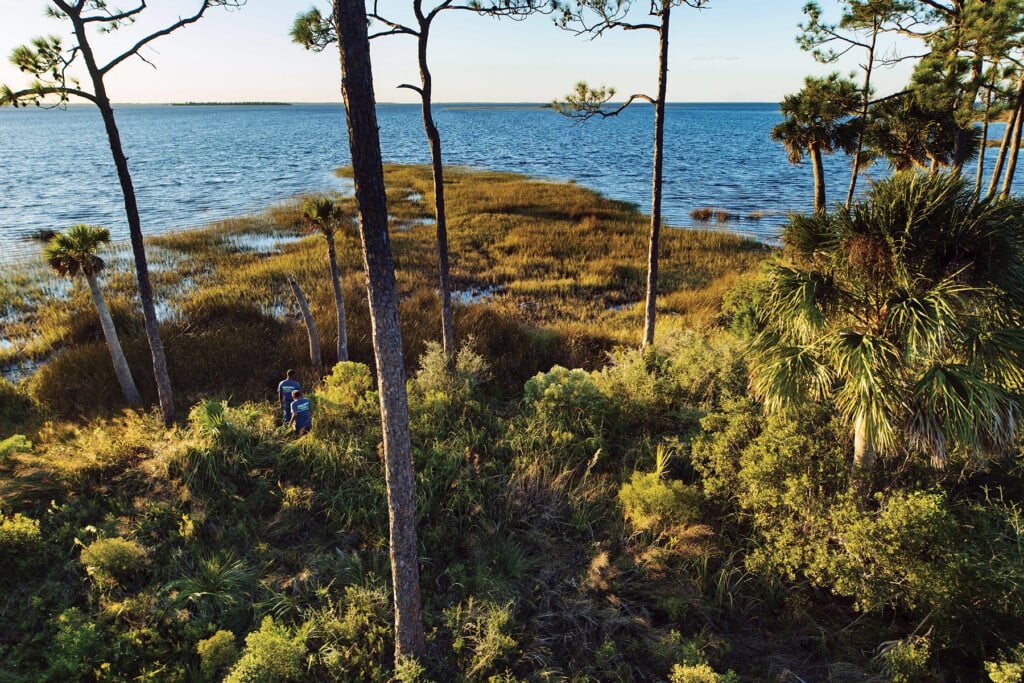
Northwest Florida is emerging as an under-recognized hub for coastal resilience expertise, anchored by engineering, environmental science, flood modeling, and civil infrastructure firms that serve both public agencies and private developers. The region’s unique geography, from the Forgotten Coast and Big Bend to the Gulf Panhandle, makes it a frontline for sea-level rise, storm surge risk, stronger hurricanes, and intensifying development pressure. These forces drive demand for science-based planning, regulatory permitting, infrastructure design, and ecological restoration solutions.
In recent years, Florida’s Panhandle and the Big Bend Coast have been hammered by climate-related events. The term “Coastal Resilience” is becoming a steady stream of high-valued projects, such as flood studies, stormwater master planning, living shoreline construction, post-storm forensics, and permitting, all of which will affect business trends now and in the future.
Though there are lessons in here somewhere on the “Broken Window Fallacy” from Economics 101, the fact remains that climate solutions are driving large-budget projects along the coast and surrounding region. The growth signal isn’t one giant megaproject. It’s the accumulation of dozens of smaller public and private developments, funded through state resilience programs and federal hazard-mitigation pipelines, and by entrepreneurs seeking to minimize risk to businesses and homes near the Gulf.
Living Shorelines are Reshaping Coastal Resilience
As climate-driven storms intensify along the Gulf Coast, coastal entrepreneurs, homeowners, and local governments are being forced to reassess how they manage long-term risk. Traditional gray infrastructure, such as seawalls, bulkheads, and riprap, often carries high maintenance costs and can fail abruptly during extreme events. Living shorelines are increasingly being viewed as an alternative form of climate resilience that also aligns with long-term economic realities.
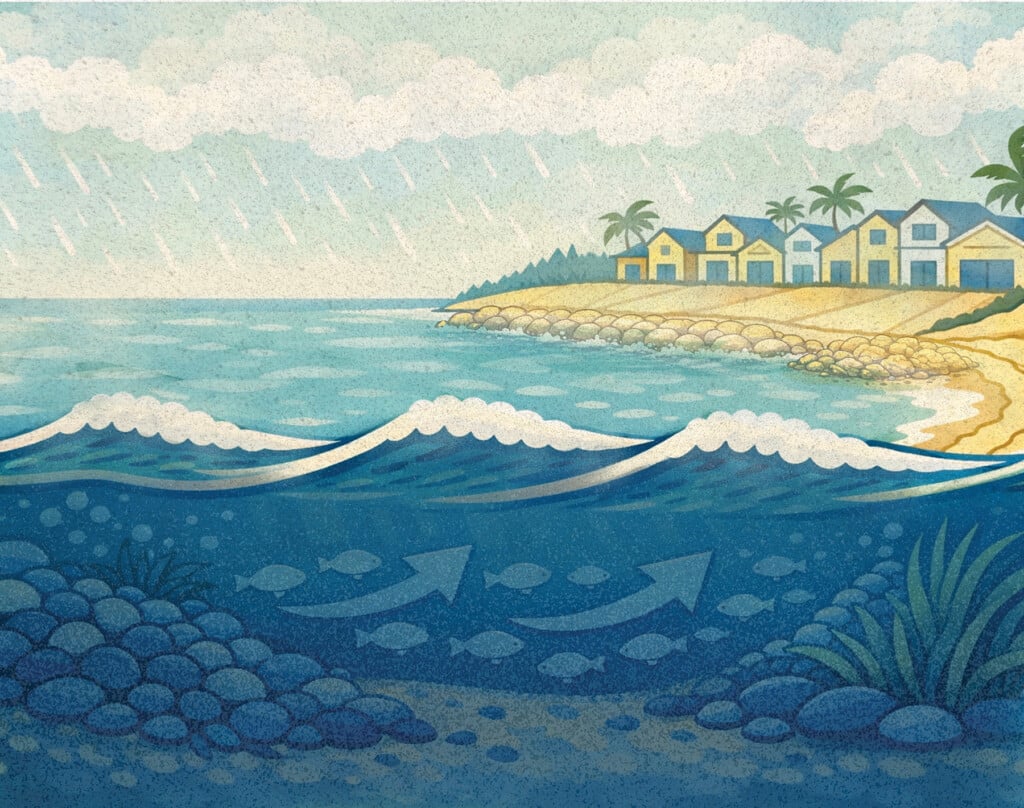
“A common misconception I hear sometimes with living shorelines is it’s for storm events,” says Will Mather, who works on living shoreline projects across Florida’s Panhandle. “Yes, it will help with storm events, but it’s not stopping storm surge.” Instead, he explains, living shorelines reduce wave energy before surge arrives, limiting erosion and lowering damage to upland areas.
Unlike static barriers, living shorelines adapt to environmental changes, such as rising seas, and they foster an environment for habitation.
“The reefs are inert when we first put them out, but they getcolonized by oysters, barnacles, other organisms,” Mather explains, “and over time, that rock that was kind of loose is locked in place.” As sea level rises, those systems adjust naturally, growing vertically as oysters accumulate and marshes migrate inland.

That adaptability is central to their value under accelerating climate risk. “A living shoreline 50 years down the road … maybe it’s bigger now,” Mather says. “We don’t have to maintain it. The organisms maintain it.” From a cost perspective, reduced long-term maintenance is one of the strongest economic arguments for living shorelines, particularly for rural communities with limited tax bases.
“The first thing that we do is identify a grant funding source,” Mather says. Counties, regional planning councils, and small municipalities are often focused on day-to-day operations and do not have dedicated grant writers. Once funding is secured, projects move into design
and construction.
That funding model also shapes local economic outcomes. For a living shoreline project in Franklin County, bid criteria were designed to prioritize nearby contractors.
“One of our primary goals was local economic development,” Mather says. Construction firms and subcontractors were drawn from within minutes of the project site, many with direct ties to the region’s struggling oyster fishery.
The climate benefits have already been tested. After Hurricane Helene passed near one project site, Mather returned to inspect the shoreline.
“Behind the living shoreline, the damage was reduced,” he says, while adjacent properties without protection experienced severe erosion. “I was half-expecting to see carnage, he says, “and it just shrugged it off.”
As coastal risk continues to rise, living shorelines are increasingly being viewed not simply as environmental restoration but as climate-resilient infrastructure, reducing damage, lowering long-term costs, and channeling resilience funding back into the communities most exposed to risk.
Climate Risk Is Forcing a Recalculation Along the Coast
Increased climate-driven weather events are forcing coastal entrepreneurs and homeowners to reevaluate their exposure to risk. Stronger hurricanes, heavier rainfall, and more frequent billion-dollar disasters are no longer abstract future threats; they are active economic variables shaping insurance markets, construction costs, and long-term business viability in coastal regions.
According to data from NOAA, the United States has experienced a sharp rise in weather and climate disasters causing more than $1 billion in damages, with both the frequency and cumulative cost of these events increasing over the past several decades. For coastal communities, that trend translates directly into higher insurance premiums, reduced coverage availability, and growing pressure on both homeowners and small businesses to demonstrate resilience, proactively.
That shift toward pre-event mitigation is central to research conducted by the Insurance Institute for Business & Home Safety (IBHS). In post-event analysis following Hurricane Ian, IBHS researchers documented dramatic differences in structural performance tied to construction choices.
“Metal roofing, we observed failure rates of less than 5%,” says Sarah Dillingham of IBHS. By contrast, homes with asphalt shingle roofs experienced failure rates “just over 50%” under similar conditions.
The implication, Dillingham emphasizes, is not that structures can be made invulnerable but that risk can be meaningfully reduced. Those reductions matter not only to homeowners but to insurers modeling loss exposure and to businesses weighing the cost of disruption versus investment in mitigation.

“With inflation the way it’s been in the last several years,” Dillingham explains, “things just cost more to replace. So it’s just all more important that with the changing of the hazards, and the vulnerabilities that we know exist in our built environment, that we’re setting ourselves up so the next generation can have stronger homes and businesses to perform.”
What distinguishes IBHS’s work is how those conclusions are reached. “We have more than 90 structures on-site,” Dillingham explains, referring to the organization’s aging farm, where residential buildings are exposed to real-world conditions over time. Roofing systems and attachments are tested after 5, 10, and even 20 years of aging, allowing researchers to assess long-term performance rather than short-term laboratory strength alone. That approach reflects a growing recognition that resilience must persist over decades to remain economically meaningful.
IBHS also evaluates the strength of residential building codes across 18 Atlantic and Gulf Coast states. “We rank states on a score of 0 to 100,” Dillingham says, describing a standardized system updated every three years. Stronger codes consistently correlate with lower losses, a finding that reframes building standards as financial infrastructure rather than regulatory burden.
The economic stakes of those correlations are substantial. In the case of Hurricane Ian, IBHS estimates that improved mitigation measures could have reduced losses to single-family homes by as much as “$1 billion to $3 billion.” For insurers, that scale of loss avoidance influences pricing and solvency. For coastal entrepreneurs, it affects downtime, rebuilding costs, and long-term insurability.
As climate risk accelerates, the lesson. emerging from both national data and IBHS research is clear: Resilience is no longer optional. It is a business decision that increasingly determines whether coastal communities can remain economically viable in the decades ahead. ▪
The ROI argument
Resilience spending is increasingly treated like an “investment,” not a cost. A major reason resilience work keeps getting funded is due to the cost-benefit assessment. The National Institute of Building Sciences’ mitigation research, supported by federal agencies, is widely cited for showing that federal mitigation grants can return about $6 in benefits for every $1 invested when factoring in reduced losses.
A separate 2024 economic study promoted by the U.S. Chamber of Commerce and partners argues that every $1 spent on resilience and preparedness saves
$13 in damages, cleanup, and broader economic impacts in the modeled disasters. For North Florida officials trying to justify stormwater upgrades or shoreline work, those figures matter because they help unlock grants and match dollars.

By the Numbers
Coastal Climate Resilience in Florida’s Panhandle
Public investment in coastal resilience across the Florida Panhandle is increasingly focused
on projects that reduce long-term risk while protecting infrastructure, ecosystems, and local economies.
Franklin-98 Living Shoreline (Franklin County)
$8.3 million initially awarded for living shoreline and marsh restoration
20 acres of estuarine reef restoration
Approximately 30 acres of intertidal marsh restoration
Protects up to 12 miles of shoreline along U.S. Highway 98
Project administered through the Apalachee Regional Planning Council
Pensacola Bay Living Shoreline — Phase 1 (Escambia County/ NAS Pensacola)
$1.56 million approved for planning and implementation
Approximately 24,800 linear feet of oyster reef and rock breakwater
Approximately 205 acres of emergent marsh and submerged aquatic vegetation habitat
Includes dedicated funding for advance planning and permitting
St. Joseph Peninsula Beach Nourishment & Coastal Structures (Gulf County)
Approximately 830,000 cubic yards of sand placed along roughly 1.1 miles of shoreline
Eight submerged breakwaters constructed offshore
Project responds to erosion exceeding 1.3 million cubic yards recorded between 2019 and 2023
Modeling indicates up to a 40% reduction in background erosion
Modeling also indicates up to a 50% increase in sand retention compared to nourishment alone
Construction scheduled for March 2026
St. Andrew & St. Joseph Bays Estuary Program (Regional)
$200,000 state grant to develop a living shoreline planning tool in partnership with Florida State University Panama City
Thirty monitoring sites across St. Andrew, Choctawhatchee, and Pensacola bays
$750,000 in additional funding supporting a three-year regional water-quality initiative
Resilient Florida Planning Grants (Panhandle Communities)
Bay County countywide vulnerability assessment: $150,000
City of Lynn Haven vulnerability assessment: $160,000
City of Panama City resilience planning: $274,000
Planning grants serve as the pipeline for future construction and mitigation funding
Why It Matters for Business
Together, these projects represent tens of millions of dollars in public investment aimed at reducing infrastructure risk, stabilizing insurance exposure, protecting transportation corridors and coastal assets, and directing grant funding into local construction, engineering, and environmental services. For coastal communities, resilience is increasingly functioning as economic infrastructure, not just environmental protection.
Climate Risk & Mitigation:
What the Numbers Show
→ National Climate Risk
The U.S. has experienced a steady increase in billion-dollar weather and climate disasters, with both frequency and total cost rising over recent decades (National Oceanic and Atmospheric Administration).
Coastal states account for a disproportionate share of insured losses due to hurricanes, flooding, and wind-related damage.
→ IBHS Research Findings
< 5% observed failure rate
for metal roofing systems after Hurricane Ian
> 50% observed failure rate for asphalt shingle roofs under similar conditions
90-plus residential structures monitored at IBHS’s aging farm
Roofing systems tested after 5, 10, and 20 years of real-world exposure
18 Atlantic and Gulf Coast states evaluated in IBHS’s residential building code scorecard
0–100 scoring system, updated every 3 years
$1 billion–$3 billion estimated loss-reduction potential for single-family homes in Hurricane Ian through improved mitigation