Window Washing Goes High-Tech
Cleaning high-rise buildings with drones
When Ryan McKillip, a former renewable-energy safety professional, first saw drones that were inspecting massive wind turbine blades, he was immediately intrigued. Traditionally, to perform this work, rope-access crews rappel hundreds of feet from the top of a turbine. After viewing this, McKillip quickly recognized how drones changed things. Inspections that once took days could now be completed in hours, allowing multiple turbines to be evaluated in a single day, which was far safer and more efficient.
This realization inspired McKillip to consider whether drones could also handle other hazardous, hard-to-reach tasks, such as pressure-washing the exteriors of tall structures. McKillip dove in and began researching the technology and discovered Lucid Bots, a Charlotte, North Carolina-based company specializing in drones for pressure and soft washing. Within months, he left his job, purchased a Lucid Bots drone, and moved to Florida’s Emerald Coast to be closer to family. The area, with its many high-rise buildings and exposure to salty air and algae, provided an ideal location to launch his start-up, H2ODrone, in July 2025.

Photo by Boo Media
McKillip notes that luxury apartments and condominiums are often built on sloped terrain or near ponds, making lifts impractical and ladders unsafe. Despite these challenges, exterior cleaning has long relied on ladders, lifts, and harness systems, which are costly, time-consuming, and hazardous.
“Drones are changing that model, revolutionizing high-risk building cleaning and maintenance by offering a safer alternative,” says McKillip, who runs the company with his brother Chris. “There is significant demand for this service, especially across Florida’s Panhandle because we can reach challenging areas without putting people at risk.”
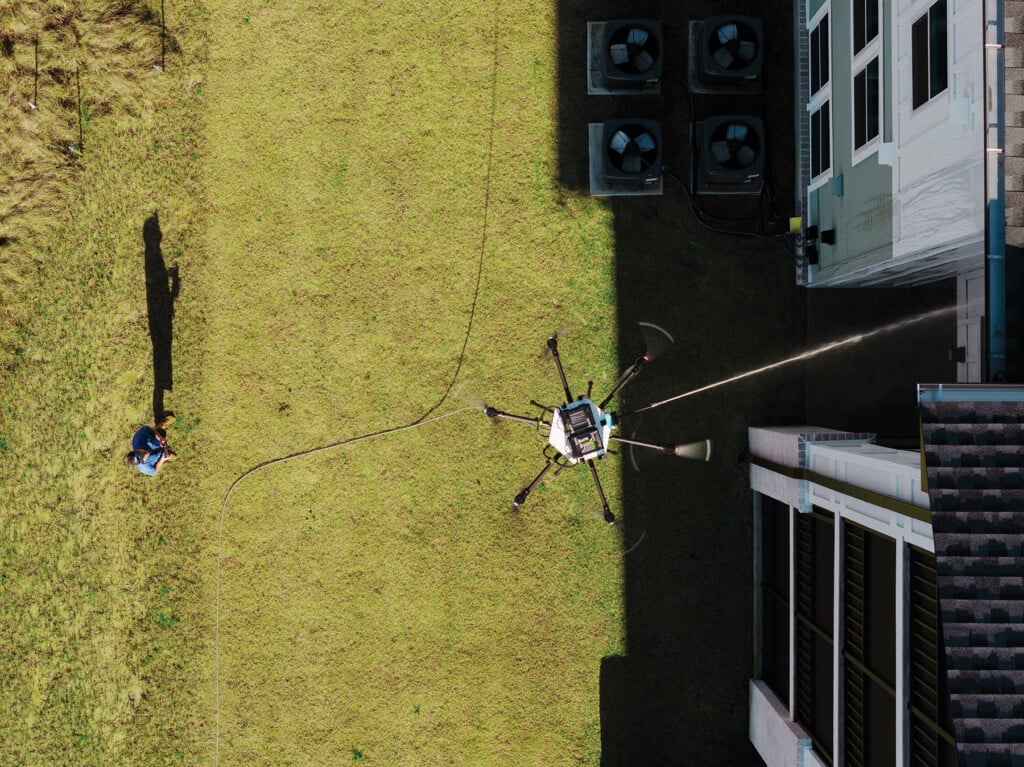
McKillip’s drone features a 5-foot wingspan from blade tip to blade tip. An attachment beneath the aircraft carries a payload of chemicals to remove organic growth, salt, and grime and is capable of rinsing the surfaces afterward with clean water. Powerful motors allow the drone to withstand pressures up to 3,500 PSI and spray up to 8 gallons per minute while maintaining stability. It can also operate at lower pressures for soft washing, such as window cleaning. Pricing for drone use is determined by total square footage and the complexity of each project. When the job is complete, the drone can fold compactly for transport in a specially equipped truck.

Photo by Boo Media
“We also use the drone for maintenance cleaning of rooftop solar panels,” McKillip says, “Solar panels collect the same buildup as siding and roofs. If they’re dirty, they’re not producing the power people paid for.”
American House Bluewater Bay, a five-story senior independent-living apartment complex in Niceville, Florida, had its exterior cleaned and was pleased with the results.
“We’ve received quotes for traditional pressure washing,” says Yoly Ostertag, the facility’s executive director. “And the cost for those was much higher. For high-rise buildings like ours, the lifts alone make the job more expensive because the daily rental rate is so high. We didn’t have to worry about that with the drones because they made the job faster. One great byproduct of having drones do the job was that our residents loved watching and were really engaged.”

Photo by Boo Media
“Safety is at the core of everything we do,” McKillip says, “for us and for our clients.”
This focus on safety extends beyond equipment. As an FAA Part 107-licensed drone pilot, McKillip coordinates with airspace authorities, including Eglin Air Force Base. Before each job, he files flight requests and notifies officials before and after daily operations to ensure compliance with restricted airspace requirements.
“Many people fly drones without fully understanding the airspace,” he says. “With the amount of flight training that occurs around places like Eglin every day, authorities want to know exactly where unmanned aircraft are operating.”
Unlike many drones, McKillip’s aircraft is tethered to a ground-based system by a hose that supplies water and limits its range. “It physically can’t just take off and go somewhere else,” he explains. “That tether offers another layer of safety.

Photo by Boo Media
“The goal is to grow the company and eventually expand into cleaning structures such as water towers and coastal infrastructure,” notes McKillip, “but we want to do it the right way by starting small, staying safe, and remaining professional.”
McKillip’s original concept, still in development, is ambitious. He aims to become the first company in the United States to wash large commercial wind turbines using drones, a service that has yet to be successfully implemented at scale.
For now, McKillip is focused on demonstrating that drones can handle even the most dangerous maintenance jobs, eliminating the need to put people at risk. ▪