Bright Ideas
The National Academy of Inventors welcomes four Florida State University faculty members
Since its unassuming beginnings in 2009 as a luncheon for patent-holding faculty at one of Florida State University’s “neighbor” schools, the University of South Florida, the National Academy of Inventors (NAI) has settled in the academic scene as the premier organization recognizing academic inventors. Today, the NAI boasts almost 300 chapters at member institutions in 19 countries and two tiers of membership for individuals: Fellows and Senior Members. Senior Members are active faculty whose innovative spirit and inventions are poised to revolutionize their industries. They are the high-impact inventors changing the world—or just about to.
Four faculty members at Florida State University were chosen to join the 2025 cohort of Senior Members (a group of less than 800 members in total): Drs. Hoyong Chung, Prashant Singh, Branko Stefanovic, and Yaacov Petscher. From plant-based plastics to Atlantic shrimp, their research has put the gears in motion for healthier and fairer futures.

Photos by Mark Skalny
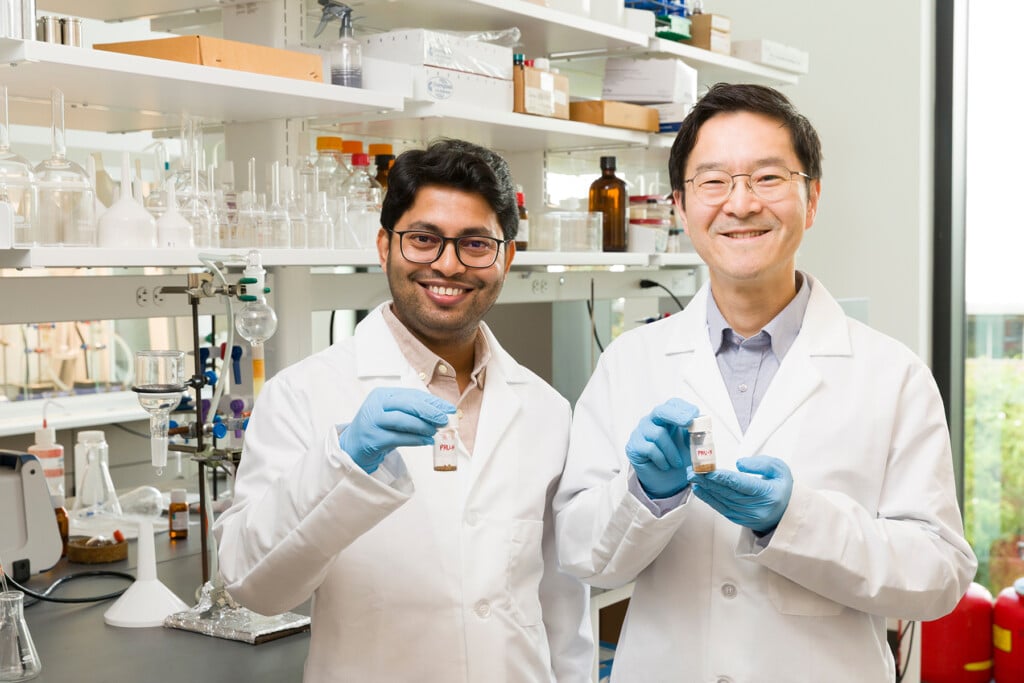
Hoyong Chung
In 2025, there’s one thing almost everyone seems to agree on: Plastic is bad. Plastics pollute, shed microplastics, deplete resources, diminish the value of objects, and accumulate inside the human body, causing an untold number of potential health complications.
Hoyong Chung has set out to complicate this idea, explaining, “Many people misunderstand [and believe] that plastic is so bad, so we have to use less. This is kind of true, because of course, we should use less classic plastics,” Chung says, like plastic bags offered by Walmart or Target, but our interactions with plastic shouldn’t end with an outright boycott.
“We should not just kill studies in plastics,” Chung purports but instead increase support for researching to design better plastics. Chung has designed nontoxic, biodegradable plastic that is safe for the environment.
Chung is a polymer scientist who uses organic chemistry to synthesize new polymers, which are large molecules consisting of many smaller molecules in a repeated pattern, resulting in many of the common materials we know and use. All plastics are polymers, but not all polymers are plastics. Some are natural, like lignin—a polymer found in the cell walls of plants (similar to cellulose), helping to make stems and leaves rigid. It’s a plant byproduct commonly seen as waste. This polymer is the basis of Chung’s plastic innovations.
Using lignin, Chung’s group has designed and synthesized a new biomedical adhesive that is not only as strong and flexible as plastic but works wonderfully in the presence of water. Combined with its nontoxic properties, it’s an excellent option for surgical applications and is already in use in collaboration with the Mayo Clinic in Jacksonville, Florida.
Chung’s adhesive is being used as a patch placed on the trachea to relieve chronic coughing for elderly patients, as it resolves issues with thinning tissue in the area. “It’s not really a risky surgery,” Chung explains, and “if [surgeons] start to use this adhesive, then [they] can reduce the surgery time substantially,” allowing more patients to be treated. So far, the collaboration has been successful.
The Hoyong Chung Group recently moved into a lab in Florida State University’s brand-new Interdisciplinary Research and Commercialization Building. Judging by the array of samples, impressive, specialized equipment, and tests in progress throughout the group’s gleaming space, Chung’s work in the field has just begun.

Photos courtesy of Florida State University
Prashant Singh
Bags of steaks, chicken, clams, and shrimp might seem more suited to a top chef’s kitchen than to an inventor’s lab, but in Prashant Singh’s built-from-scratch workspace, the bounty behind the refrigerator and freezer doors isn’t for cooking; it’s for testing. Each sample helps advance the development of his invention, RIGHTTest™, a tool designed to verify species authenticity in seafood.
Singh has eaten a lot of shrimp, he says, smiling. Fishermen tend to give bags, even boxes, as gifts. After all, the work Singh is doing has already made a tangible impact on the seafood industry and fishermen’s livelihoods. His invention, RIGHTTest™, validates the species of a small sample of seafood product, guaranteeing authenticity in market and restaurant settings. Seafood mislabeling and fraud is an increasingly prominent issue in the industry; the market for Atlantic white shrimp is a prime example. This highly desirable species, caught along the Atlantic Coast from New York to Florida, is often substituted with cheaper species (like those farmed in the Pacific) that are virtually identical to the untrained eye. Not only does mislabeled seafood rob the consumer of value but some specimens can be toxic.
RIGHTTest™ can reliably verify the species of raw or cooked shrimp (even seasoned) within two hours. Years of development have resulted in a portable device about the size of a cooler (it can even be placed in a stroller). One of Singh’s graduate students, Hanna Victoria Brown, who stands in the lab defrosting a bag of what looks like Cajun shrimp, explains how handy the device has become. She just returned from a seafood festival in Alabama, where she checked vendors’ products on the spot. If a vendor had mislabeled a fraudulent product (which most often happens on day two), she explains, they are fined and suspended from the festival.
Even outside of the festival scene, “When people see seafood at a restaurant by the water,” Singh says, “people assume the product is authentic and coming from the body of water they are looking at, which is frequently not the case. Our goal is to support and fight for our domestic fishermen who are in need of our help.”
Singh believes consumer demand is paramount in driving academic research. It’s already clear that RIGHTTest™ fills a pressing need in the industry and will keep rolling out all over the South.

Photos courtesy of Florida State University
Branko Stefanovic
When Branko Stefanovic joined a group of scientists studying the liver at the University of North Carolina Chapel Hill, he took the first step in life-changing research for treating liver fibrosis. Liver fibrosis, which is most commonly associated with fatty liver disease, affects a significant amount of the general population, particularly those who struggle with obesity, hepatitis, or alcoholism. Liver fibrosis occurs when the long fibers that form liver tissue are damaged repetitively, forming scar tissue that’s less supple and resilient. Often, people “don’t know they have [fibrosis],” Stefanovic says, until a doctor finds it in an advanced stage.
Stefanovic has studied fibrogenesis for over 20 years, as well as research on preventative antifibrotic agents capable of slowing or even reversing liver fibrosis.
Fibrogenesis is the process by which normal tissue is replaced with scar-like fibrotic tissue, often following chronic injury or inflammation. A key hallmark of this process is the excessive deposition of Type I collagen, the primary structural protein produced by activated fibroblasts and myofibroblasts. By inhibiting the production of Type I collagen, researchers aim to interrupt the cycle that drives fibrosis. When Type I collagen synthesis is reduced, the extracellular matrix does not accumulate as rapidly, which limits tissue stiffening and disrupts the feedback signals that further activate fibroblasts. In essence, blocking collagen formation prevents the “scaffold” of scar tissue from developing, allowing normal tissue repair and regeneration to proceed instead of pathological scarring.
Stefanovic has discovered three such inhibitor molecules that could be key for developing new treatment options, with one treatment currently in preclinical trials, the first step toward getting his drug to market.
“Once we discover something that may be useful,” Stefanovic says, “then it has to be [adopted by] big pharma,” but the road is not quite that simple. Toxicology tests, according to Stefanovic, are of particular importance for maintenance therapy for chronic diseases like fibrosis. Typically, preclinical trials assess safety, efficacy, and mechanisms of action, using in vivo murine models before proceeding to phase I human trials. Getting a treatment to market can as much as 15 years.
Though the road is long, Stefanovic urges other academic researchers, “Don’t limit yourself,” and to research for the sake of research. Once intellectual property has been protected, an innovation can be discussed in terms of next-level application. “About half of [academic researchers] have this kind of spirit,” Stefanovic says cheerfully. One can’t help but imagine a world where that figure is closer to 100%.

Photos by Mark Skalny
Yaacov Petscher
When we think of inventions or innovations, physical products most likely come to mind. But patents, particularly utility patents, are much more inclusive than what can be held in hand. Yaacov Petscher is certainly familiar with this fact. Petscher, a professor, associate dean of research at Florida State’s College of Social Work, and associate director for the Florida Center for Reading Research (FCRR), has an “inventorship portfolio” containing less commonly considered innovations, such as algorithms, assessments, and even a graphic novel. His goal is to improve literacy in all students, with a special focus on those with disabilities or other challenges.
“My training is in developmental quantitative psychology,” Petscher clarifies. “Even going back to grad school, I’ve always been interested in how we can create better measures and better assessments for people.” While not limited to educators, Petscher’s work is highly relevant to teachers, especially those who need to be responsive to changing legislation. His tools broaden the scope for students’ classroom assessment, leading to more precise snapshots of ability.
And these tools have already made a tangible impact. “With my colleagues at FCRR,” Petscher says, “we created the state’s first large-scale computer adaptive assessment in reading for kindergarten through 12th grade.” One purpose of computer-adaptive assessments is to adjust question difficulty in real time, enabling advanced learners to demonstrate their full proficiency while presenting students who struggle with questions aligned to their current skill level, thereby reducing frustration and discouragement. These assessments provide educators with clear insights, making it simpler to target and strengthen students’ areas of need.
Petscher believes, “Kids are more than the sum total of their grades or their performance on exercises in the classroom,” claiming countless and often overlooked personal factors affect their development. “Sometimes the reason that a child is struggling … is because they came to school hungry,” Petscher says, or that neurodiversity and self-regulating behaviors might be in the picture. “Maybe there was a trauma at home that their parents experienced or the child has experienced.”
Petscher’s future innovation goals reflect this holistic thinking. “I would love it if the kinds of tools we are trying to build were inclusive of trauma and behavior, and nutrition, reading, and language,” Petscher explains, which would be possible, “if we had a bigger table that more people were sitting at to talk about the nature of what we do for a child.”
Collaborating with academic publishers, combined with Petscher’s keen eye for innovation, may well be the key to turning these aspirations into reality for schools nationwide. ▪
![Istock 2170151371 [converted]](https://wpcdn.us-midwest-1.vip.tn-cloud.net/www.850businessmagazine.com/content/uploads/2026/08/d/x/istock-2170151371-web-hero-1024x699.jpg)